
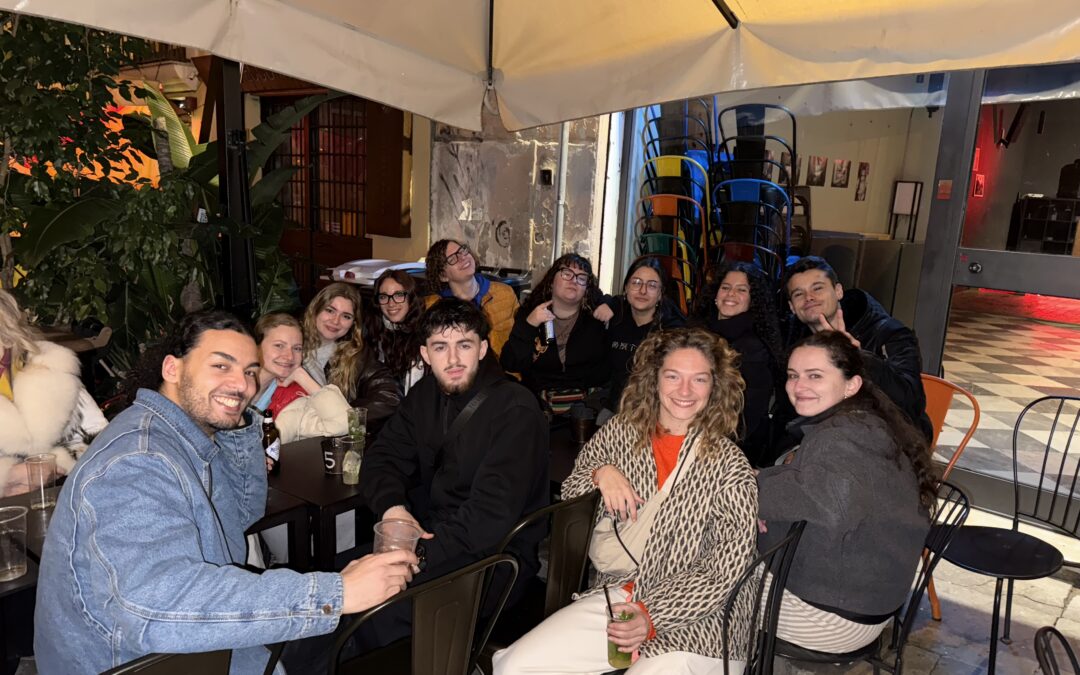
Exactly a week ago the project came to an end, and it is now time to return to the everyday rhythm of Barcelona. But how do you return when your mind is still filled with Sicilian scents, loud conversations that lasted late into the night, and the feeling that you have just completed an important puzzle? And when somewhere in the subconscious there is still an echo of Arabic, French and Italian mixing together, while traces of mosaic glue remain on your fingers? To avoid falling into a post-project dopamine crash after such a week, the participants and I decided first to pause and reflect. It turned out that staying silent was not an option for anyone.
From 22 February to 2 March, Palermo hosted the international youth exchange “Let’s Tassellate!” within the Erasmus+ programme, organised by HRYO. The name refers to tessellation, a technique in which fragments fit tightly together without leaving any gaps. The group itself looked exactly like that: young people from Spain, France, Italy, North Macedonia, Morocco and Turkey who spent a week exploring themes of equality, inclusion and intersectionality together.
The programme was designed so that conversation would not remain abstract or dull. Every morning began with World Café discussions where topics emerged from real personal stories, followed by workshops and group reflections, all of which eventually took shape as collective art objects made from recycled materials. The mosaics and collages were not simply a decorative ending to the week but a way to express what could not fully be put into words during discussions. Participants worked in international teams, and the final presentation of the artworks became a kind of moment of “connecting the dots” between everything that had been discussed before.
Several participants from the Spanish team have already shared their impressions.
Daniil Luzan wrote honestly:
“Taking part in the Erasmus+ project ‘Let’s Tassellate’ was by far the best decision I could have made for my vacation. I feel incredibly grateful to carry home so many new experiences, memories, and connections.”
He also noted that the diversity of the group itself became a living illustration of the project’s theme: representatives of eight countries with different cultural contexts discussed inclusion while practising it daily within a shared space.
Mariia Petrenko, who is herself experiencing integration into Spanish society, describes the experience from another perspective:
“The dialogue I managed to settle during the activity hours and after with all the amazing people who came there definitely left a mark on me. It helped me understand not only the broader challenges many societies face, but also the deeply personal struggles that individuals carry with them.”
For her, the project unexpectedly became a new lens through which to see her own reality. Through conversations with participants from different countries she saw Spanish culture in a different way, which perfectly describes the mechanism of such exchanges: you travel to observe others and return with a new perspective on yourself.
Another important point on the map of the week was Terra Franca, land once confiscated from the mafia and returned to the community of Palermo. Today it hosts an ecological and social hub with permaculture, educational projects and grassroots initiatives. For participants who had just spent several days discussing social change and the struggles of different communities, the place became a living example that such changes truly happen.
If you are reading this now and somewhere in the background a thought appears – “maybe I should also try to join an Erasmus+ youth exchange?” – then perhaps you should.
Thanks to Daniil and Mariia for their comments
Material prepared by Olha Oltarzhevska